
Single source of truth in a CCMS
Single source of truth is the most-quoted phrase in structured-content decks. What it means in a CCMS, and what decides if you really have one.
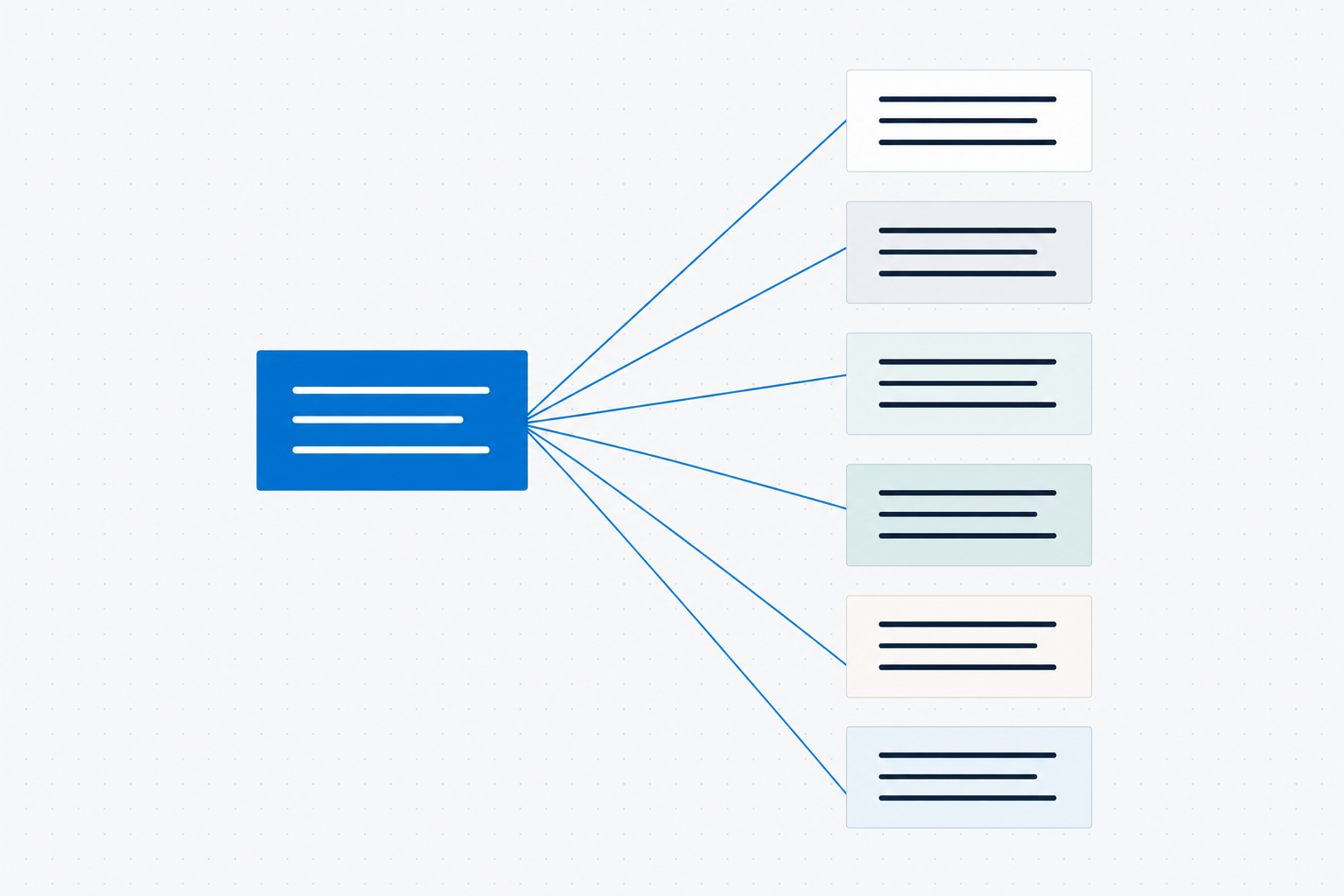
Single source of truth is the most-quoted phrase in structured-content sales decks. It is also the most misused. Used carefully, it describes a specific architectural property of a content estate. Used carelessly, it is a synonym for “we tried to be tidy this time.”
This post is the careful version. What the phrase actually means in a CCMS. The four places it pays for itself. The architectural choices that decide whether you really have one.
The strict definition
A single source of truth is the same approved fragment (a paragraph, a procedure, a warning, a definition) stored once and referenced by every document that uses it. A change made to the source fragment propagates to every referencing document automatically. The fragment is the source; the referencing documents are derivatives.
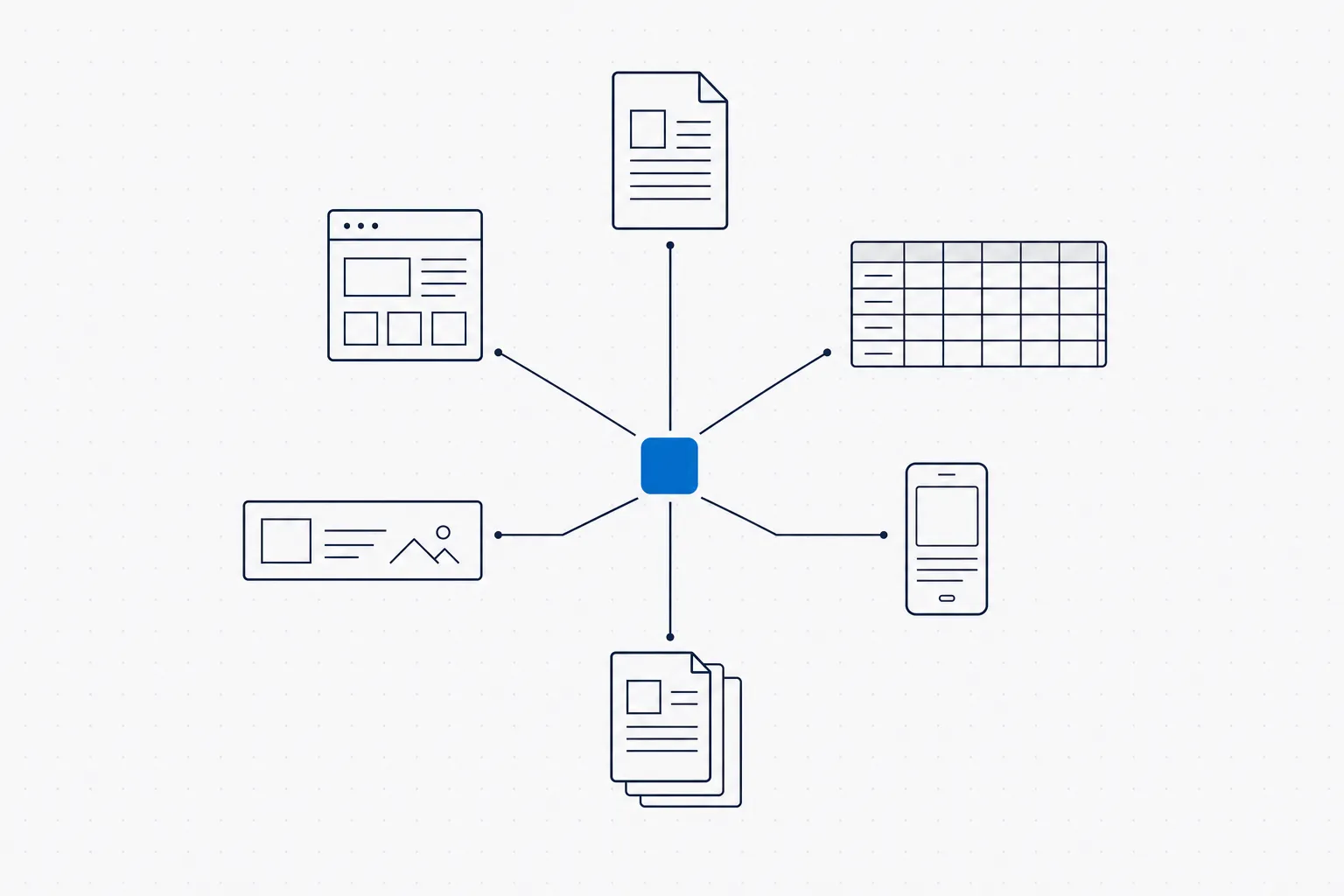
Single source of truth in one picture: one canonical component, many downstream renderings. The discipline is that the source is the authoritative version and the outputs are projections of it. Changing an output without changing the source is what breaks the model.
The diagnostic question is brutal: when you change the source fragment, does every place it appears actually update, without a manual sweep?
If yes, you have a single source of truth.
If no (if you have to remember to update the other places where the fragment appears, or if a script runs to copy the change across, or if there is a “synchronization” step that someone has to trigger) you have a reuse pattern, not an SSOT. The reuse pattern is better than nothing. It is not the architectural property the sales deck is describing.
The distinction matters because the four places an SSOT pays for itself depend on the strict property, not the loose one.
Where it pays for itself
Translation cost. This is usually the easiest case to make in a finance review. Documents are translated; the per-word rate is the visible cost. In a document-centric world, each document is translated independently, twenty country labels means twenty translation jobs. When the source updates, twenty translation jobs run again. We walked the math in detail in Translation cost in technical documentation; the short version is that most teams underestimate the bill by a factor of three to five because they count the per-word rate and miss the per-update multiplier.
With a real SSOT, one source change is one translation job. The translation memory matches against the actual unit of change rather than the document that contains it. The downstream documents refresh from the translated source. The arithmetic differs by an order of magnitude.
Audit response time. The regulator asks who approved a specific safety statement, when, and against which version of which regulation. In a document-centric world, the answer requires a reconciliation across every document that contains the statement, with the corresponding approval records for each. The reconciliation can take days or weeks. For EMA pharmacovigilance, the response window is seven days; reconciliation does not fit.
With a real SSOT, the statement is one component with one approval record. The answer is a query, not a reconstruction. The audit window stops being load-bearing on the system; the system answers inside whatever window the regulator sets.
Regulatory consistency. This is the same property the audit response uses, but pointed at prevention rather than response. In a document-centric world, the safety language in the Brazilian label might or might not match the approved CCDS, depending on whether the last update propagated cleanly or whether the manual sweep missed Brazil. The mismatch is the audit failure mode.
With a real SSOT, the consistency is structural. The Brazilian label references the same approved fragment as every other label. There is no copy to drift. There is no manual sweep to fail.
Downstream automation. This is the half of the picture that grew in importance fastest between 2020 and 2026. Chatbots, AI assistants, RAG systems, and downstream operational tooling consume the content estate to answer questions. In a document-centric world, the AI returns text from whichever PDF happened to be indexed; the text may be the current approved version, an older approved version, or a draft that someone uploaded by mistake.
With a real SSOT, the downstream consumer reads the current approved fragment. The AI answer is structurally aligned with the most recent approval. The hallucination failure mode is constrained by the content architecture, not by the model.
This was the original argument behind structured content for bots, made a decade ago and republished because the prediction held: Bot-enabled? called it in 2016; the 2026 LLM wave runs on exactly that architectural assumption.
Three architectural choices that decide whether you actually have one
The phrase is quoted loosely enough that systems that produce reuse patterns get marketed as single sources of truth. Three architectural choices separate the real thing from the loose thing.
Granularity. A CCMS that holds whole sections as components does not produce a real SSOT. The unit of reuse has to be small enough that the same component appears in many documents: typically at the paragraph, procedure, or warning level. If your CCMS holds the entire “Pharmacology” section as one component and the same Pharmacology section appears in three labels, you have three copies of the substance information inside the section component, and you are back to the reconciliation problem at sub-section granularity.
This is the half of the picture DITA gets right by construction. DITA topics are typically small enough that the same topic naturally appears in many maps. Conrefs go one level smaller, to the paragraph or list-item level. The DITA model assumes the granularity question is settled in favor of small components.
References vs copies. A CCMS has to use content references that resolve at publishing time, not pre-resolved copies. DITA’s conref and conkeyref are the mechanisms; the diagnostic question is whether the referencing document holds a pointer to the source or a snapshot. If a snapshot, the snapshot can be edited independently and the SSOT property is broken.
This sounds technical but matters in practice: some CCMS platforms allow authors to “detach” a referenced fragment for local edits, which silently downgrades the SSOT to a reuse pattern. The architecture has to disallow that, or to flag it loudly enough that it is an explicit decision rather than an accident.
Substrate. The components have to live in a system that is itself the source of truth for identity, audit, and approval, not a system that sits next to those records. If the CCMS stores the components but the approval records live in a separate quality system, the SSOT is split across two systems, and reconciliation between them is the audit failure mode.
The architectures that handle this cleanly hold the approval record at the component, in the same system as the component itself. For organizations on Microsoft 365, the natural shape is a CCMS on the SharePoint substrate, where the approval records, audit logs, and component metadata are all SharePoint primitives. For organizations on other substrates, the same principle applies; the substrate just looks different.
The 80% case
In our experience the 80% case for an SSOT looks like this. The organization has a repeating-content problem (labeling, technical documentation, SOPs, regulatory submissions) where the same approved language appears in many documents. The cost of keeping the copies aligned is paid in translation bills, audit reconciliation, and regulatory inconsistency. The DITA-based CCMS holds the language as components at the right granularity, references them through conref/conkeyref into multiple maps, and publishes the resulting documents through DITA-OT.
The change in operating posture is sharper than the technology change implies. The teams that produce documents stop thinking of documents as the unit of work. They think of components as the unit of work. The documents are outputs. The components are the durable artefact. This shift is the half of the implementation that takes the longest; the tooling installs in weeks, the way of thinking takes a couple of years to bed in.
The reward is the four payoffs above, in order of how visible they are at first. Translation cost lands in the next budget cycle. Audit response time lands at the first major regulator interaction after go-live. Regulatory consistency lands quietly across the year. Downstream automation lands when the next AI assistant project tries to consume the content estate and discovers, for the first time, that the answers are consistent.
For the category-level treatment of CCMS independent of any specific vendor, see the CCMS pillar page. For the underlying architectural decisions that decide whether a CCMS program lands, see Choosing a CCMS, six questions that decide the evaluation. For the product expression of all of the above in the Microsoft-native architecture, Dx5 Overview.
Frequently asked questions
What does 'single source of truth' actually mean in a CCMS?
It means the same approved fragment (a paragraph, a procedure, a warning) is stored once and referenced by every document that uses it, rather than copy-pasted into many documents and then drifting apart between updates. A change made to the source fragment propagates to every referencing document automatically. The phrase is widely misused; the diagnostic question is whether a change you make in one place actually updates everywhere that fragment appears, or whether you still have to do a manual sweep.
How is this different from copy-paste reuse?
Copy-paste produces independent copies. After three updates, the copies diverge, different markets have different versions of what should be the same warning, and reconciling them is a manual project. Content references in a CCMS produce one stored fragment with many pointers to it. The next update changes the stored fragment; every pointer resolves to the updated version automatically. The pointers do not need to be edited.
What does an SSOT pay for itself in?
Four places, in order of how often we see them justify the implementation. (1) Translation cost, one source change is one translation job, not twenty. (2) Audit response time, the answer to 'who approved this exact wording' is one record, not a reconciliation across twenty documents. (3) Regulatory consistency, the safety language in the Brazilian label is structurally guaranteed to match the approved CCDS. (4) Downstream automation: chatbots, AI assistants, and RAG systems get the current approved fragment, not a stale copy from a PDF that hasn't been re-indexed.
What architectural choices decide whether you actually have an SSOT?
Three. (1) Granularity, components have to be small enough that the same component appears in many documents; a CCMS that holds whole sections does not produce a real SSOT. (2) References vs copies, the CCMS has to use content references that resolve at publishing time, not pre-resolved copies. (3) Substrate: the components have to live in a system that is itself the source of truth for identity, audit, and approval, not a system that sits next to those records. If any of these three is wrong, you have a reuse pattern, not an SSOT.
Can you have a single source of truth without DITA?
In principle yes; in practice almost no implementation at meaningful scale. DITA's content reference (conref), content key reference (conkeyref), and ditaval profiling primitives are the mechanisms that make component-level reuse practical. Other structured-content formats (DocBook, custom schemas) can do the same in theory, but the tooling ecosystem and the established patterns are stronger in DITA. The honest answer is: if you're serious about single source of truth, you're likely going to end up in DITA whether you started there or not.