
Clinical trial protocol templates 2026
TransCelerate, FDA/NIH and ICH M11 protocol templates explained. What changed in 2026, how they relate, and how to use them in a structured content workflow.
Read postYour content is managed in documents. Your organization is not. Authored in Word, governed in SharePoint, with Dx5 doing the structural work behind the scenes.
See how it worksUsed in regulatory and regulated industries by








Four products, in the order you meet them. Each one does a single job, and all four run inside the Microsoft 365 you already have.
The content you already have, brought in as components.
Explore DxMigrationTool PlatformContent management and publishing inside Microsoft SharePoint.
Explore Dx5 AuthoringStructured DITA authoring inside Microsoft Word.
Explore DxAuthor+ QualityRule-based content quality across the SharePoint repository.
Explore DxCheckerIt shows up one way for the people who do the actual writing, another for everyone who has to read and sign that writing off, and another again for the people on the buying committee. Start wherever your seat is.
The scientist, engineer, clinician, regulator, pilot or lawyer who writes the content. Authors in Microsoft Word through DxAuthor+; structure happens behind the scenes. The same role shows up at EASA writing the rule and at GKN Fokker writing the manual that has to comply with it.
See how SMEs work in DitaExchange
The larger group, and the one most content programs count last: for every author there are several people who have to read, comment on and sign off what the author wrote. They comment on the component that changed rather than re-reading the document, and the sign-off is recorded against a version as it happens.
See how review and approval work
IT, quality and the people who have to approve a new platform rather than use it. Their questions are structural: whose infrastructure the content sits on, how many user lists the organization ends up maintaining, and what the exit looks like in ten years.
See what IT review asks for
Every organization we work with arrives at the same three problems. Different orders, different industries, same structure underneath.
Consistency is not a style preference in regulated content, it is the audit position. Update a component once and every document, web page and app that uses it reflects the change, automatically and without a manual sweep.
Every approval, version and change is captured as it happens, so when the question comes the answer is already structured.
Subject matter experts, reviewers and approvers all contribute in the tools they already know, while the governance, structure and reuse happen behind the scenes. No XML editor, and nothing new to learn for the person whose only job is to sign off.
One component lives in a single place, and every document that uses it draws from that source on demand, so a change made once takes effect everywhere without a manual sweep.
The same defects an auditor finds in a review are the ones a language model repeats with confidence. The fix is upstream, in how the content is structured and checked before anything reads it.
| What AI reads from documents | What AI reads from DitaExchange | |
|---|---|---|
| Terminology | The model speaks the wrong term. | Versioned components ground what it can cite. |
| Cross-references | The agent passes a dead link through. | Checked by DxChecker before publication. |
| Metadata | It answers without knowing what the reader was asking for. | Inline and component-level metadata carry the context: whether this is a procedure, a concept or a process. |
| Source of truth | The answer cites the version you retired. | One approved source feeds every output. |
| It repeats it, with complete confidence. | Content it can quote without going wrong. |
What structured content management means in practice, and how review and approval are captured against the component rather than the document.
Both videos load from YouTube only when you press play, so nothing third-party runs on this page until you choose to watch.
DitaExchange runs on Microsoft SharePoint, SharePoint Online (included in your Microsoft 365 subscription) or SharePoint Server on-premise. Subject matter experts author in Microsoft Word, desktop or web.

That is the practical difference between DitaExchange and every other structured content system on the market. Others ask you to adopt their infrastructure. We work inside yours.
How Dx5 works The European Union Aviation Safety Agency adopted DitaExchange to power eRules, the platform that produces the Easy Access Rules format now used across European aviation. The first deliverable, Initial Airworthiness, went live in February 2018, and the platform has been in continuous production use ever since.
Modular content is tagged, organized and reused inside SharePoint, with version history captured at every step of the editorial workflow. The rule-authors continue to work in Microsoft Word, no separate XML editor to learn, no parallel toolchain to maintain alongside the regulator's existing Microsoft estate. Every change, every approval and every version is preserved at the workflow, ready to be re-published to whichever audience needs it next.
A regulator writes the rule. An aerospace prime, a defense supplier or a nuclear operator has to turn it into its own procedures and prove, at the next audit, which rule each procedure implements. Both sides maintain long documents with a handful of authors and many more reviewers, and both pay for every sentence that exists in two versions.
EASA, the European Defence Agency and the Canadian Nuclear Safety Commission write their rules on DitaExchange. Lockheed Martin and GKN Fokker run it on the receiving side. The same pattern shows up in financial services, technical documentation and life sciences, with different consequences.
Agencies, authorities, exchanges and standards bodies that write the rules others follow, amended continuously and cited by everyone downstream.
Primes, suppliers and operators turning EASA, FAA and NATO rules into their own procedures, and proving which rule each one implements.
Licensing documents, operating procedures and plant safety cases, where the audit trail is itself the deliverable.
Disclosures, policy documents and controlled publishing, with governance enforced in the workflow rather than described in a process document.
Modular content for product portfolios, where each new variant draws from the validated pool so the work stays incremental instead of duplicated.
Regulatory submissions, labeling and clinical documentation, where the answer needs to be ready before the regulator asks for it.
The Easy Access Rules format EASA publishes on DitaExchange reaches more than 20,000 stakeholder companies across European aviation, every operator, airline, training organization and manufacturer that has to comply, from one component library.
The European Union Aviation Safety Agency has published European aviation regulations on DitaExchange since February 2018, drafted in Word, stored in SharePoint.
Rule-makers run it (EASA, the European Defence Agency, the Canadian Nuclear Safety Commission) and so do the organizations they regulate (Lockheed Martin, GKN Fokker, Grundfos).
The common thread is not a sector. It is content whose inconsistency carries a regulatory, legal or financial cost. See the customers running this architecture, or the regulated-industries focus behind it.
DitaExchange runs inside your Microsoft 365 tenant. Identity, access control, data residency, and the underlying audit log are the ones your IT and compliance teams have already approved. We add the structure on top. Every component versioned. Every approval captured. Every change traceable to the person who made it.
Inherits the platform's identity, access control and tenancy posture, with no parallel infrastructure to certify.
Every approval, version and change is recorded as it happens, not reconstructed from email threads when an auditor asks.
Component identity and version history are built to support 21 CFR Part 11 style submissions and equivalent regimes.
Define the rules once, from terminology to required metadata, and every file in your SharePoint repository is checked automatically.

TransCelerate, FDA/NIH and ICH M11 protocol templates explained. What changed in 2026, how they relate, and how to use them in a structured content workflow.
Read post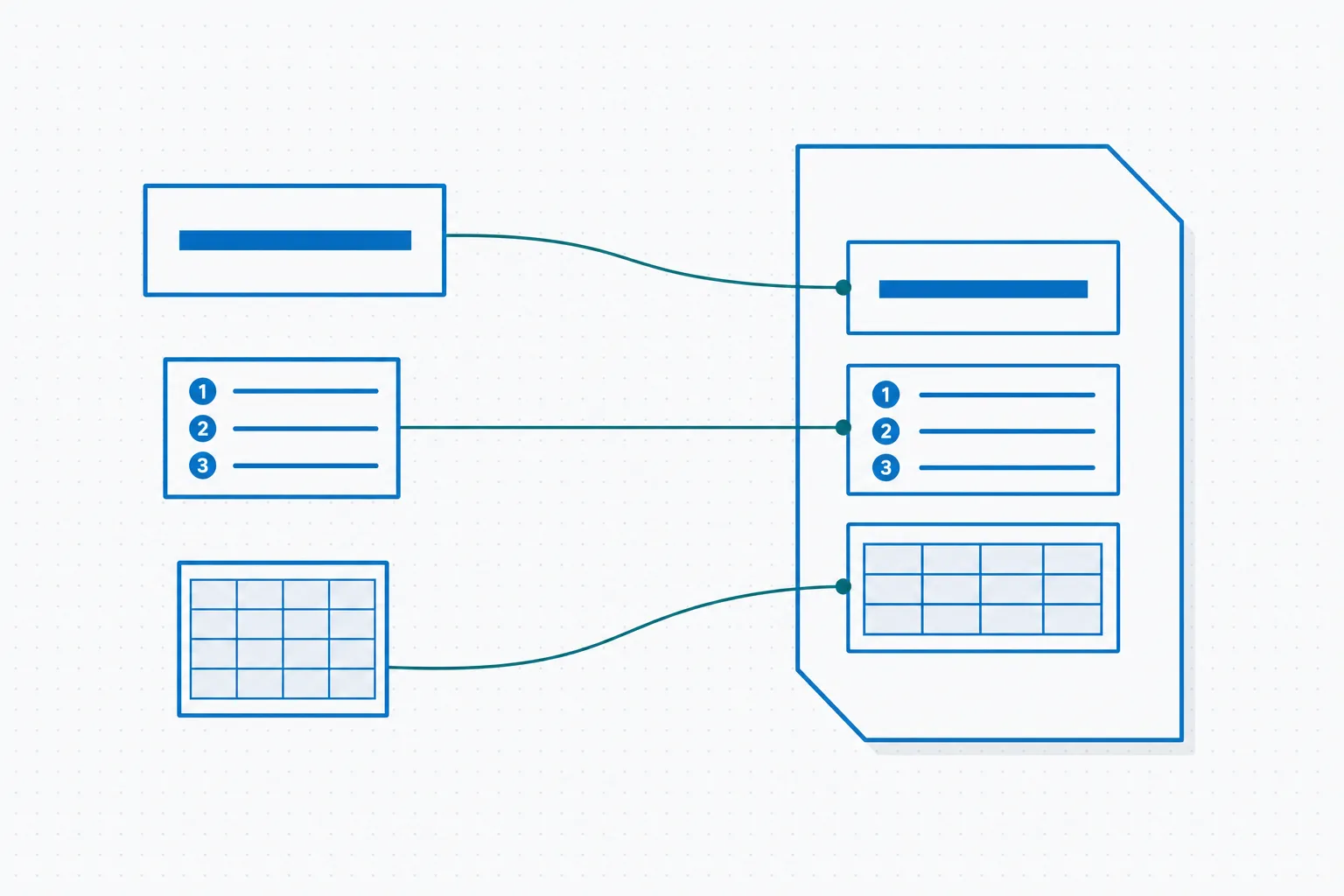
Topic-based authoring means writing small, self-contained units that stand alone or assemble into documents. The mechanics, failure modes, and habits.
Read post
A CCMS that integrates with SharePoint is not the same as one that runs on SharePoint. The structural difference, and why it matters on Microsoft 365.
Read postYou do not need to rework your whole content operation to see results, most teams begin with a single pain point and build out from there as it proves itself.