
Clinical trial protocol templates 2026
TransCelerate, FDA/NIH and ICH M11 protocol templates explained. What changed in 2026, how they relate, and how to use them in a structured content workflow.
Read postThe Danish company behind DitaExchange, the component content platform that runs DITA inside Microsoft SharePoint and is authored in Microsoft Word.

DitaExchange manages content as DITA components inside Microsoft SharePoint, and assembles documents from those components on demand. Subject matter experts (medical writers, regulatory specialists, engineers, compliance officers, financial analysts) continue to author in Microsoft Word. The structure layer, the reuse mechanics, the review workflow and the audit trail work behind the scenes.
That design choice carries a practical consequence. Adopting Dx5 is a SharePoint application decision, not a new-platform decision. The legal, procurement, security and data-residency conversations the customer's IT department would otherwise hold are largely answered before they begin, because the answers are the same ones already given for SharePoint itself.
DITA is the open standard for structured content: component-oriented, reusable, and consistent enough that a paragraph approved once can appear in thirty documents without being retyped. It is the architecture the product is built on, not a format we invented.
Exchange is the harder half. Structured content only pays for itself when the people who own the subject matter can work with it directly, and not only the specialists who know the tooling. That is why authoring happens in Microsoft Word rather than in an XML editor, and why reviewers and approvers take part from the tools they already have.
It is the part we are still working on every day.
DitaExchange is the platform behind some of the most documentation-intensive regulatory work in Europe. EASA has been publishing European aviation regulations on Dx5 since February 2018, the platform behind the eRules program and the Easy Access Rules format used across European aviation. CNSC publishes Canadian nuclear safety regulations on it.
EASA, Lockheed Martin, the European Defence Agency and GKN Fokker: regulatory rules content, technical documentation and capability frameworks.
MagVenture: labeling and regulated content held to component-level approval.
The Canadian Nuclear Safety Commission publishes Canadian nuclear safety regulations on Dx5, on multi-decade asset lifecycles.
LSEG: financial disclosures assembled from approved components, with the audit trail captured as the content moves.
Grundfos: product documentation reused across product families and languages instead of rewritten per variant.
The common thread is not the sector. It is the cost of inconsistency, the regulatory expectation of traceability, and the practical advantage of working inside the Microsoft platform IT already runs. The customers set out what each program actually publishes.
DitaExchange ApS is headquartered in Aarhus, Denmark, with a US presence in Radnor, Pennsylvania, supporting North American customers. The company operates as part of Wirtek A/S, a Danish IT services and solutions company listed on Nasdaq First North Growth Market Denmark under the ticker WIRTEK.

Engineering, customer delivery and platform operations are based in Aarhus, alongside the teams that work with European customers.

Customer-facing teams operate from both Denmark and Pennsylvania to cover European and North American customers across compatible business hours.
The customers DitaExchange supports run multi-year programs on Dx5. That shape of customer relationship sets the shape of how the company operates.
EASA's relationship with DitaExchange is in its eighth year of continuous production use, publishing European aviation regulations throughout.
Nuclear and energy customers run assets whose documentation has to outlast several platform migrations. DITA storage keeps the content portable across them.
Implementations begin with one document set, one editorial team, one SharePoint site. From there the platform scales with the customer's content program.
The conversation continues over years, not quarters.
DitaExchange ApS is a Danish company and part of Wirtek A/S, which is listed on Nasdaq First North Growth Market Denmark under the ticker WIRTEK. DitaExchange Inc. in Radnor, Pennsylvania is the US subsidiary that supports North American customers. For a customer the practical effect is a small Aarhus product company with a listed parent behind it. Questions about group structure or financials belong with Wirtek.
DitaExchange is a Microsoft partner and its products are Microsoft 365 certified. The SharePoint integration is built with SharePoint Framework, which is Microsoft's own extension model, and identity runs through Entra ID single sign-on. There is no forked version of Word: authoring happens in the standard Microsoft Word the tenant already licenses. Supported deployments cover SharePoint Online, SharePoint Server 2019 and SharePoint Server Subscription Edition.
Four. DxMigrationTool imports content that already exists, reading Word, HTML, Markdown and plain-text files and componentizing them into DITA topics. Dx5 is the server component: content management and publishing inside SharePoint. DxAuthor+ is the Word add-in that applies DITA structure while subject matter experts stay in Word. DxChecker enforces content rules across SharePoint repositories, covering terminology, ISO 8601 date formats, required metadata and prohibited phrases.
In your own SharePoint tenant, wherever that tenant already sits. Components are stored as DITA XML in SharePoint document libraries, so data residency, encryption, retention and audit logging stay whatever your organization has already configured for SharePoint. National-cloud Microsoft 365, SharePoint Server on-premise and air-gapped installations are supported, which is why a sovereign customer runs the same product line as everyone else.
EASA has published European aviation regulations on it since February 2018, and that program has run continuously ever since. The Canadian Nuclear Safety Commission publishes Canadian nuclear safety regulations on it. Those two are the useful reference points for longevity, because both are regulators whose published output has to stay correct and citable for years rather than for a release cycle.

TransCelerate, FDA/NIH and ICH M11 protocol templates explained. What changed in 2026, how they relate, and how to use them in a structured content workflow.
Read post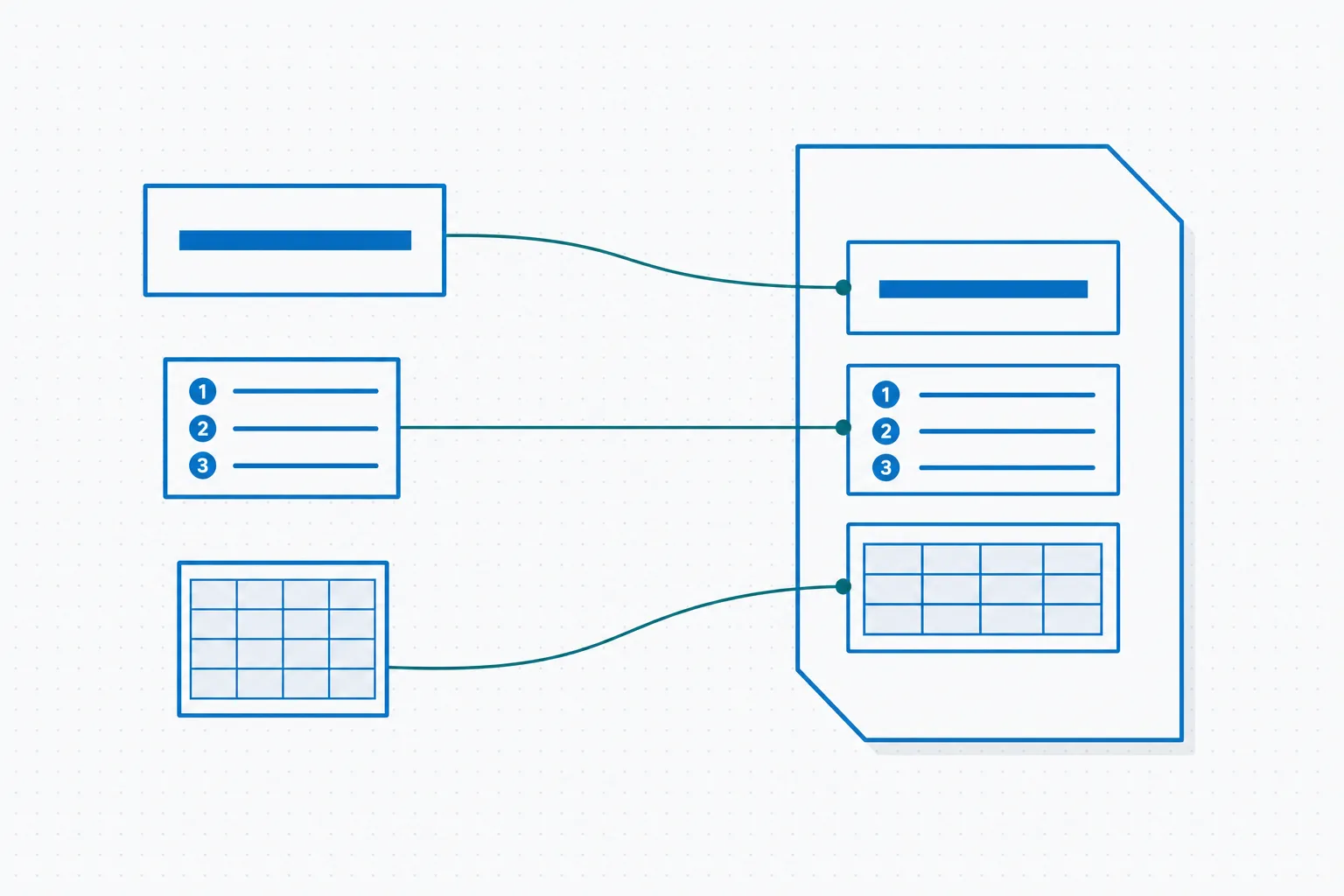
Topic-based authoring means writing small, self-contained units that stand alone or assemble into documents. The mechanics, failure modes, and habits.
Read post
A CCMS that integrates with SharePoint is not the same as one that runs on SharePoint. The structural difference, and why it matters on Microsoft 365.
Read postMost early conversations are about whether structured content is right for your program, not implementation. Happy to have that talk with no sales process attached.